
Potential Savings With MEFE Sterilisers
Posted by Maddie McKaskill on 24th Apr 2026
Knife Sterilisation in Meat Processing: Improving Efficiency, Compliance & Cost Savings
Knife sterilisation in meat processing environments such as abattoirs and butcher shops is critical for maintaining hygiene, ensuring food safety, and protecting product integrity. As operational costs rise and equipment design evolves, businesses must adopt sterilisation methods that are not only effective but also energy-efficient and practical for real-world use.
Recent industry research has explored alternative time–temperature combinations for sterilisation. However, in day-to-day processing environments, consistency, reliability, and ease of use remain the most important factors—making traditional hot water sterilisation at higher temperatures the most practical approach.
Why Knife Sterilisation Matters in Meat Processing
Strict hygiene standards apply across the meat industry, and contaminated tools can quickly compromise product safety. In high-throughput environments, knife sterilisation must be fast, consistent, and effective without relying on perfect operator behaviour.
For this reason, knife sterilisers are typically operated at 82–85°C. This temperature range provides rapid bacterial reduction while allowing for the variability that naturally occurs during processing.
Beyond compliance, consistent sterilisation helps:
- Reduce cross-contamination risks
- Maintain product quality and shelf life
- Protect brand reputation
- Support safe and efficient workflows
Alternative Time–Temperature Research: What It Means in Practice
Recent research, including the MLA report on alternate time–temperature combinations, indicates that lower temperatures (such as around 75°C) can achieve similar microbial reduction when combined with a defined exposure time. Read the full report here: Alternate Time-Temperature for Knife Sterilisation – Final Report.
While this is scientifically valid, it is important to understand the conditions behind these findings:
- Consistent and complete immersion of the knife
- Accurate and stable water temperature
- A minimum exposure time (e.g. 2 seconds) achieved every time
In controlled environments, these conditions can be met. However, in real processing settings:
- Knives are often dipped quickly—sometimes less than 2 seconds
- Immersion depth can vary between operators
- Temperature can fluctuate within the steriliser
Because of this variability, higher operating temperatures remain the most practical and reliable approach. Operating at 82–85°C provides a built-in safety margin that ensures effective sterilisation even when conditions are not perfectly controlled.
Cost-Efficiency of Insulated Hot Water Sterilisers
When evaluating sterilisation methods, insulated hot water sterilisers remain the industry benchmark for reliability and cost-efficiency. Compared to UV or chemical sterilisation systems, hot water solutions offer a simpler and more robust approach.
Chemical systems introduce ongoing consumable costs and require careful rinsing, while UV systems can be less effective when organic matter is present. Hot water sterilisation avoids these limitations by delivering consistent results without added complexity.
Key advantages include:
- Proven and reliable pathogen control
- No reliance on consumables
- Reduced labour for pre-cleaning
- Lower long-term operating costs
For businesses looking to optimise their setup, explore MEFE knife steriliser solutions.
Common Inefficiencies in Traditional Hot Water Systems
Despite their effectiveness, many traditional hot water sterilisers are inefficient. A common design involves continuously introducing near-boiling water to maintain temperature, resulting in constant overflow.
This leads to several issues:
- Water wastage: Cooled water is discharged rather than reused
- High energy use: Fresh water must be constantly reheated
- Temperature inconsistency: Heat is unevenly distributed throughout the unit
- Increased operating costs: Utilities are unnecessarily high
As water rises through the unit, it cools—often dropping below effective sterilisation temperatures—before overflowing. This not only wastes resources but also reduces overall system efficiency.
Reference note: Validate typical temperature drop and overflow rates in conventional systems if supporting data is required.
Modern Sterilisation: A Smarter, More Efficient Approach
Modern steriliser design focuses on control, efficiency, and consistency. Rather than relying on continuous overflow, newer systems use targeted heating and insulation to maintain stable temperatures.
Key improvements include:
- Thermostatic temperature control
- Internal heating elements
- Reduced water loss
- Improved insulation for heat retention
These features ensure that water is heated only when necessary and maintained at the correct temperature throughout the unit.
MEFE Sterilisers: Designed for Real-World Performance
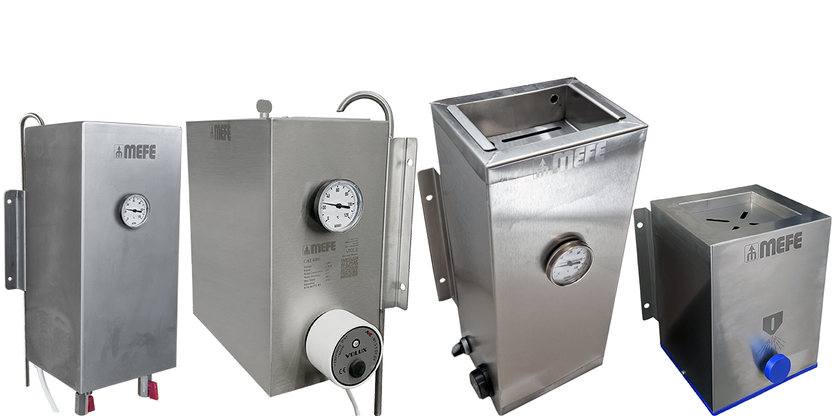
MEFE sterilisers are designed to address the inefficiencies of traditional systems while maintaining consistent sterilisation performance.
Key features include:
- Cold water introduced at the base of the unit
- Internal heating to maintain ~85°C
- Thermostatic control to reduce energy use
- Surface skimming to remove fats and oils without excessive drainage
This design minimises water waste and ensures a more uniform temperature throughout the steriliser, improving both efficiency and reliability.
Explore the full range at MEFE.com.au.
Measuring Your Savings Potential
Upgrading to a modern sterilisation system can deliver measurable savings in both water and energy usage.
Factors influencing savings include:
- Daily operating hours
- Water consumption
- Energy usage
- Current system efficiency
To estimate your potential savings, use the MEFE Savings Calculator.
Best Practices for Knife Sterilisation
Regardless of the system used, following best practices is essential:
- Maintain consistent water temperature (typically 82–85°C)
- Ensure full blade immersion during use
- Regularly clean and maintain equipment
- Check thermostat accuracy
- Train staff on proper procedures
For broader industry guidance, refer to Australian Standard AS 4696 for the hygienic production and transportation of meat and meat products.
Frequently Asked Questions
What temperature should knife sterilisers operate at?
In practical meat processing environments, 82–85°C remains the most reliable temperature range for consistent sterilisation.
Can knife sterilisation work at 75°C?
Research shows it can be effective under controlled conditions with defined exposure times, but this is difficult to guarantee in real-world use.
Why not lower the temperature to save energy?
Lower temperatures require stricter control over immersion time and consistency. In most operations, higher temperatures provide a safer and more reliable outcome.
How can I reduce operating costs?
Improving system efficiency—rather than lowering temperature—is the most effective way to reduce water and energy usage.
Upgrade Your Sterilisation System Today
Efficient knife sterilisation is essential for maintaining hygiene, reducing costs, and ensuring consistent performance. While new research offers valuable insights, real-world reliability still depends on stable temperatures and well-designed equipment.
To improve efficiency without compromising standards, visit www.mefe.com.au or try the MEFE Savings Calculator to see how much you could save.